Maldon Salt admits imported German rock salt feeds its '100% sea salt' flakes
The Observer found K+S German rock salt is dissolved into Blackwater Estuary seawater at Maldon's Essex plant; UK regulators took no action, but Canadian packaging now drops the word 'sea'.
· 3 min at the table
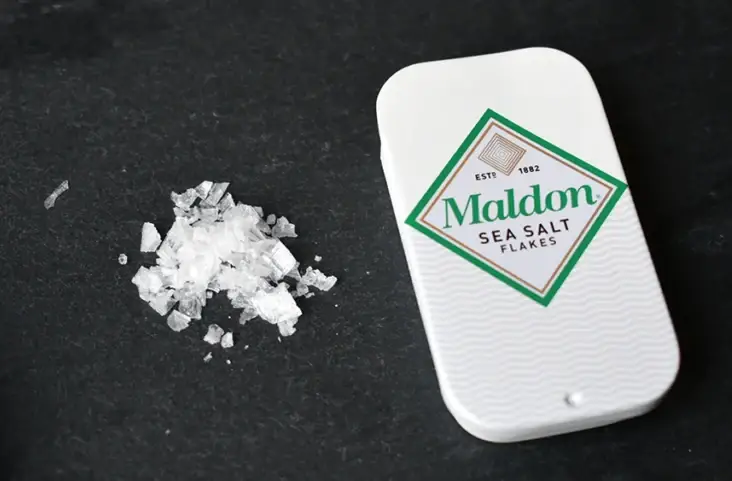
Maldon Salt has confirmed that rock salt mined in Germany by K+S is used in the production of its pyramid-shaped sea salt flakes, which retail at £2.85 per 250g box, or £11.40 per kilogram, following an investigation by The Observer.
The 144-year-old Essex brand, established in 1882, acknowledged on 18 November in an Instagram statement that it had not explained its manufacturing process clearly enough. "We've heard your concerns that our process wasn't clear enough and are committed to being clear about how and why we make our salt the way we do," the company said.
What does the investigation reveal?
The Observer found that rock salt mined by German producer K+S is delivered to Maldon's facility at Longwick Farm, near Goldhanger in Essex. Journalists monitoring the site witnessed deliveries of large bags of imported salt over a two-day period.
The imported material feeds what Maldon calls its long-established "salt-on-salt" process. Rock salt is introduced to seawater drawn from the Blackwater Estuary to create a concentrated brine. The rock salt dissolves during processing and becomes part of the brine from which the finished flakes are produced, The Observer reported.
The finding challenges the brand's packaging and promotional material, which describes the product as "100% sea salt flakes". Maldon maintains that this description is accurate. Its position is that rock salt is essentially ancient sea salt, formed through the evaporation of prehistoric seas, and that its inclusion does not change the identity or characteristics of the finished product.
What did regulators decide?
Essex Trading Standards, supported by the Food Standards Agency (FSA), investigated Maldon's production operations in 2019 and 2020. After inspections and sampling, the authorities concluded no further action was necessary.
A key factor was the absence of a specific legal definition distinguishing sea salt from mined rock salt. An Essex County Council Trading Standards spokesperson told The Observer there were no specific legislative parameters to establish whether describing a product as sea salt was accurate or inaccurate. Maldon maintains that its methods and labelling comply with all applicable food safety and labelling legislation.
The contrast with other markets is stark. The Observer reported that some Maldon packaging sold in Canada has been changed to remove the word "sea" from the product description, because Canadian labelling requirements restrict describing mined salt as sea salt.
How has Maldon responded?
Following the investigation, Maldon updated its website with greater detail on its manufacturing methods, describing the technique as traditional and in use for more than a century. An accompanying infographic set out four production stages:
- Drawing seawater from the Blackwater Estuary at high tide, when natural salt concentration peaks
- Filtering the settled water through a bed of pure rock salt to create brine
- Evaporating the brine in open pans until crystals form
- Hand-harvesting and drying the flakes
The company said the salt available to consumers is "the same as it's always been" and argued the process is fundamental to the product's signature texture, appearance and quality.
What is at stake for the premium market?
The case exposes a gap in UK labelling rules when products combine raw materials from different geographical sources. For a premium brand whose value rests on Essex coastal heritage, Blackwater seawater, open-pan evaporation and hand-harvesting, provenance claims carry direct commercial weight. The price gap against mainstream table and rock salt reflects processing, packaging and brand positioning as well as raw material, but the revelations may prompt consumers to reassess what the premium covers.
Maldon has pledged greater transparency. Whether regulators revisit the absence of a legal definition for sea salt, or further markets follow Canada's labelling approach, will shape the next phase for the brand and its premium peers.
via FoodBev (Source)
More from Elena Vasquez
Show full bio
News editor covering regulation, policy and their impact on European hospitality industry at Eurotables Report.
173 articles
Other tables tonight
- UK-EU SPS deal lands 1 March 2028, but growers won't move before 2029November 22, 2026
- Nestlé sells SimplyCook to Jardox amid broader portfolio resetNovember 6, 2026
- EIT Food Study: Curiosity Alone Won't Sell Precision FermentationOctober 14, 2026
- Innocent and Notpla test edible seaweed pods in Nobottle pilotNovember 20, 2026
- Soil Association pulls organic certification from British farmed salmonNovember 14, 2026